The short answer
The closest hotel on a map is not always the easiest stay. Check the usable station exit, the route with luggage and when your room will actually be ready. Get important arrival arrangements confirmed by the property before paying for a restrictive rate.
| Check | Ask this |
|---|---|
| Arrival | Will my room be ready at my actual arrival time? |
| Access | Which station exit should I use with luggage? |
| Charges | What is the full amount including early access and extra bedding? |
| Delay | How should I notify you if my train arrives late? |
1. Match the exact station and exit
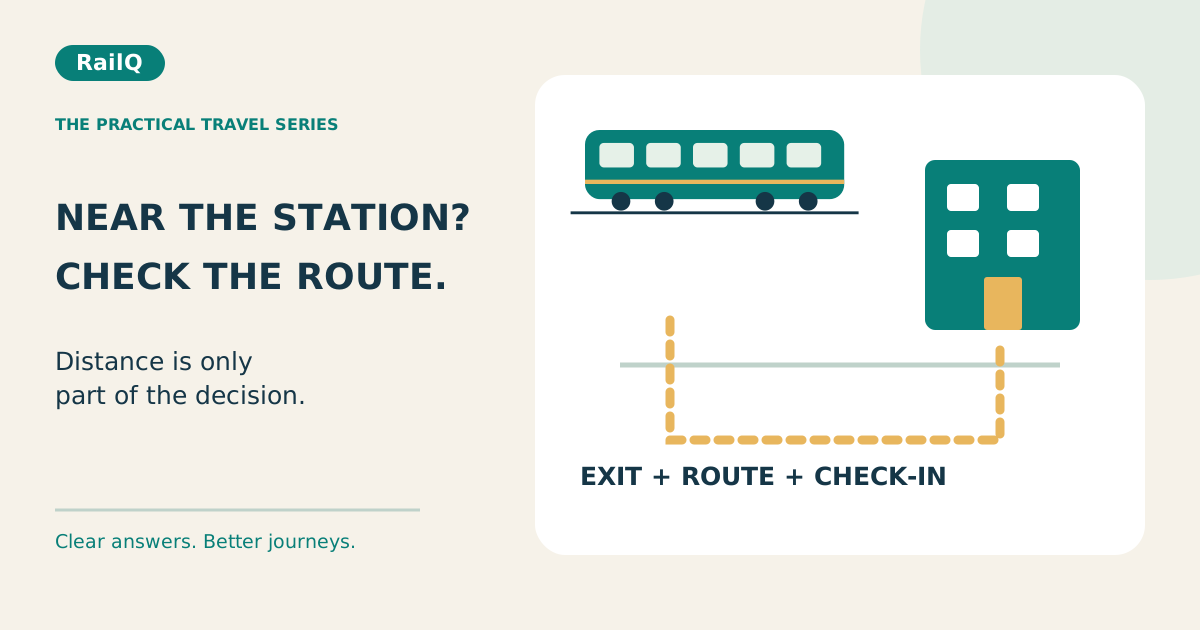
Search with the station’s full name and code, not only the city. A hotel on the opposite side of railway tracks can be close in a straight line yet awkward to reach. Ask which exit guests normally use and whether the entrance is accessible at your arrival time. In a city with several terminals, check that the hotel is near your actual arrival station.
2. Turn map distance into a usable route
Check the walking or driving route while online. Look for road crossings, footbridges and places where a vehicle can stop. A short walk with a backpack may not suit a family with suitcases or someone with limited mobility. Save the address and property contact before travel. An offline map is useful, but Google says offline walking directions are unavailable.
References: [1]
3. Separate train arrival from room check-in
A train arriving at 6 am does not make a room available at 6 am. Check the property’s published check-in time and ask whether early access is confirmed, chargeable or only subject to availability. A 24-hour reception is not a promise of 24-hour room occupancy. Booking.com’s help explains that early or late check-in requests depend on the property.
References: [2]
4. Match the room to the people travelling
Confirm the number of adults and children, bed arrangement, lift access and any assistance you need. Ask which identity documents the property accepts and check its guest policies before booking. A room labelled double may not include an extra bed. Keep written confirmation for a requirement that would make the stay unsuitable if unavailable.
5. Compare the whole stay cost
Add room charges, any displayed taxes, early check-in charges, extra bedding and transfers. A cheaper room farther away may cost more after two taxi rides. If breakfast matters, check whether it is included for every guest. Do not treat a headline nightly rate as the amount for the complete family or the full stay.
6. Read cancellation and late-arrival conditions
Write down the free-cancellation deadline with its date and time, if offered. Check what happens if the train is delayed and you arrive after midnight. Inform the property using the contact in your confirmed booking and ask how to keep the room. Cancellation rules belong to the selected rate; another room at the same hotel may have different terms.
References: [2]
7. Read recent, relevant evidence
Look beyond the average score. Read recent comments about night-time access, noise, cleanliness and the exact room category you are considering. Look for repeated themes rather than relying on one dramatic review. Verify essential claims with the property. A listing photo shows what is advertised; it is not proof that every room or access route is identical.
A worked arrival example
Your train is due at 6 am and the hotel lists check-in at 2 pm. You need a place to rest immediately. Compare a confirmed early-access charge, booking the previous night with a late-arrival arrangement, and another suitable property. A station retiring room may be an alternative where available: check the current IRCTC booking conditions and availability. Do not assume it is included with your train ticket.
References: [3]
Common questions
Is a station hotel always the best choice?
No. Compare your next day’s destination, usable transport, arrival time and total cost. Proximity is only one part of the decision.